UFC Betting Guide
Betting on UFC Fights: The Complete UK Guide for 2026
 Available in US
Data-driven picks for every fight night
By MMA Betting Analyst
- Why UFC Has Become the Fastest-Growing Betting Market in the UK
- What Every UK Punter Needs to Know Before Placing a UFC Bet
- How UFC Betting Odds Work: Fractional, Decimal, and Implied Probability
- Types of Bets You Can Place on UFC Fights
- What to Look for in a UFC Betting Site
- The UFC Betting Market in 2026: Key Numbers
- Core Strategy Principles for UFC Betting
- Live Betting on UFC: How In-Play Odds Shift
- Is Betting on UFC Legal in the UK? Regulation and Licensing
- Responsible Gambling: Staying in Control
- Frequently Asked Questions About Betting on UFC Fights
Why UFC Has Become the Fastest-Growing Betting Market in the UK
$10.3B
MMA betting handle in the US alone during 2024
43 events/year
UFC’s annual calendar of numbered and Fight Night cards
18%+ CAGR
UFC gross gaming revenue growth over the past five years
I placed my first UFC bet in 2015, three days before a Fight Night card in Glasgow. A friend had talked me into putting a tenner on a heavy underdog in the co-main — some wrestler nobody outside the hardcore forums had heard of. He won by second-round submission, and I walked away with enough to cover a week’s groceries. That was the moment I stopped treating UFC as a spectacle and started treating it as a market. Eleven years later, I still think combat sports offer UK punters something football, tennis, and horse racing struggle to match: inefficiency.
The numbers confirm what I felt back then. UFC generated $1.4 billion in total revenue during 2024, a 9% jump on the previous year, and the organisation now runs 43 events annually — 13 numbered cards plus 30 Fight Nights. That schedule creates a near-weekly pipeline of betting opportunities, far more frequent than most casual punters realise. On the wagering side, the MMA betting handle in the US hit $10.3 billion in 2024, climbing 17% year-on-year, while UFC’s gross gaming revenue has compounded at over 18% annually across the last five years. Those are not fringe numbers. That is a market accelerating past several established sports.
For UK bettors specifically, the timing is unusually good. The broader UK online sports betting market is projected to reach $5.69 billion by 2029, with 10% of the adult population already placing sports bets online. MMA is riding that wave but growing faster than the average, powered by a young, engaged demographic — 62% of UFC’s core audience falls in the 18-34 bracket, the same cohort driving mobile betting adoption.
This guide exists because the top search results for UFC betting in the UK are almost entirely bookmaker promo pages and shallow affiliate roundups. None of them include market data, integrity analysis, or anything resembling a strategic framework. I have spent the past decade building odds models for combat sports, and what follows is the guide I wish had existed when I started. Whether you are placing your first moneyline bet or refining a method-of-victory strategy, every section is built on data rather than marketing copy.
What Every UK Punter Needs to Know Before Placing a UFC Bet
- UFC betting is fully legal in the UK under UKGC regulation, and winnings are tax-free — but the regulatory landscape is tightening with the 2025 gambling levy and new affordability checks on the horizon.
- The MMA betting market hit $10.3 billion in US handle during 2024 and is growing at 18%+ annually, making it one of the fastest-expanding sectors in sports wagering.
- Choosing a bookmaker with sub-5% margins and deep UFC market coverage directly affects long-term profitability — not all platforms offer the same markets or pricing.
- Convert odds to implied probability before every bet. If your assessed probability exceeds the bookmaker’s, you have a potential value bet; if not, walk away.
- Use a unit-based bankroll system (1-3% per bet), specialise in two or three weight divisions, and track closing line value rather than short-term results.
How UFC Betting Odds Work: Fractional, Decimal, and Implied Probability
The single biggest leak I see in new UFC bettors is not poor fight picks — it is a fuzzy understanding of what odds actually represent. A punter who cannot convert a price into an implied probability is making decisions with a blindfold on. So before we get to strategies, bet types, or bookmaker features, we need to nail the mechanics of odds, because everything else in this guide rests on them.
Fractional odds — the traditional UK format, expressed as a ratio like 4/1 or 1/5. The first number is your potential profit relative to the second number, which is your stake. A 4/1 shot means four pounds profit for every one pound risked.
Fractional odds remain the default at most UK-facing bookmakers, so they deserve the deepest treatment. If you see a fighter listed at 7/2, it means the bookmaker believes — or at least prices — that fighter as having roughly a 22% chance of winning. But that “roughly” matters. Bookmakers build a margin into every price, which means their odds slightly overstate each fighter’s chance of losing. I will come back to margins shortly.
Decimal odds — popular across European markets and increasingly common on UK platforms. Expressed as a single number (e.g. 5.00 or 1.20) that represents the total return per pound staked, including your original stake. So 5.00 decimal = 4/1 fractional, and 1.20 decimal = 1/5 fractional.
Decimal odds are mathematically cleaner for quick comparisons. When I am scanning five bookmakers for the best price on a main event fight, I switch to decimal because spotting a difference between 2.65 and 2.75 is faster than comparing 33/20 with 7/4. Most UK platforms let you toggle between formats in your account settings.
Implied probability — the percentage chance of an outcome embedded in a set of odds. This is the number that actually matters for finding value, because it lets you compare the bookmaker’s view of a fight with your own assessment.
Illustrative example — not based on a real bout or real bookmaker odds.
Calculating implied probability from fractional odds
Formula: Implied probability = Denominator / (Numerator + Denominator) x 100
For Fighter A at 4/1: 1 / (4 + 1) x 100 = 20%
For Fighter B at 1/5: 5 / (1 + 5) x 100 = 83.3%
Total: 20% + 83.3% = 103.3% — the 3.3% above 100% is the bookmaker’s margin (overround).
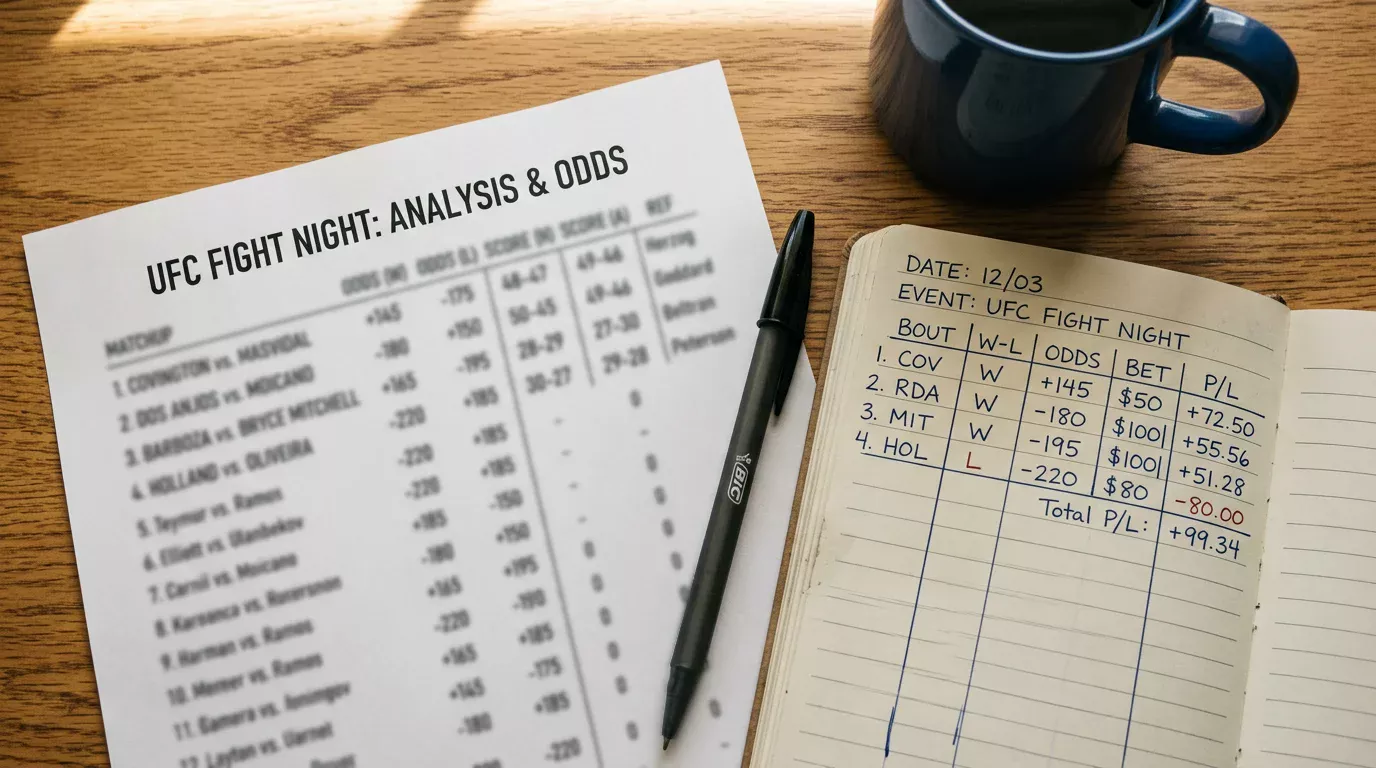
That overround is how every bookmaker earns their keep. On major UFC bouts, the combined implied probability often sits around 103-106%, meaning the house takes roughly 3-6% regardless of who wins. On major championship fights, margins at the sharpest UK operators frequently drop below 4%, which is competitive compared to most football markets. For a deeper walkthrough of every odds format, margin calculation, and line movement pattern, I have written a dedicated breakdown in UFC betting odds explained.
The practical takeaway: never place a bet without first converting the odds to an implied probability and comparing it to your own assessment of the fight. If you think a fighter has a 35% chance of winning but the bookmaker’s odds imply only 25%, you have found a potential value bet. If the implied probability exceeds your estimate, the bet is not worth taking regardless of how exciting the fighter’s highlight reel looks.
Types of Bets You Can Place on UFC Fights
One of the things that hooked me on UFC betting early was the sheer variety of markets. In football, you are mostly working with match result, correct score, and a handful of player props. In MMA, a single three-round fight can generate fifteen or more distinct betting options, each with its own risk profile and edge potential. Understanding what is available is the first step toward choosing markets that suit your analytical strengths.
| Bet Type | What You Are Predicting | Typical Odds Range | Edge Potential |
|---|---|---|---|
| Moneyline (Fight Winner) | Which fighter wins | Evens to 10/1+ | Moderate — most liquid, sharpest lines |
| Method of Victory | How the fight ends (KO/TKO, submission, decision) | 2/1 to 8/1 | High — requires style analysis |
| Round Betting | Exact round of finish or round groups | 5/1 to 30/1+ | High — volatile but mispriced on undercards |
| Over/Under Rounds | Whether the fight lasts longer or shorter than a set total | 4/5 to 6/5 | Moderate — accessible entry point |
| Proposition (Props) | Specific occurrences: fight to go the distance, first knockdown, etc. | Varies widely | Variable — wide margins but occasional value |
| Accumulator / Parlay | Multiple selections combined into one bet | Compound odds | Low to negative — bookmaker edge multiplies with each leg |
Moneyline — a straight bet on which fighter wins the bout, regardless of how or when. This is the foundation of UFC betting and where most volume concentrates.
The moneyline is where you start, but it is not where the best edges live. Because moneyline markets attract the most money and the most attention from sharp bettors, the odds tend to be efficient — meaning the bookmaker’s prices closely reflect actual win probabilities. Method of victory and round betting, by contrast, require deeper fight knowledge to price accurately, which is exactly why bookmakers sometimes get them wrong. If you can assess whether a striker is likely to finish a grappler in the first two rounds versus getting dragged into a decision, you are operating in territory where casual money rarely ventures.
Prop bet — short for proposition bet, a wager on a specific event within the fight that does not directly determine the winner. Examples include “fight to go the distance”, “total knockdowns over 1.5”, or “fighter to win in round 1”.
Props are fascinating because they carry the widest bookmaker margins but also the widest mispricings. The bookmaker’s model might nail the moneyline but systematically underestimate a fighter’s first-round finishing rate based on historical striking data. That gap is where prepared bettors profit.
Parlay (accumulator) — a single bet combining two or more selections; all must win for the bet to pay out. The combined odds multiply, creating large potential returns but exponentially lower probability of winning.
I will be direct about accumulators: the maths works against you. Every leg you add multiplies the bookmaker’s edge along with the potential payout. UFC’s upset rate — higher than most sports because one punch can end a fight — makes long accas particularly dangerous. That does not mean they are always wrong, but they demand strict discipline. For a full treatment of each market, including edge potential and realistic worked examples, read the complete guide to types of UFC bets.
What to Look for in a UFC Betting Site
I used to think a bookmaker was a bookmaker — stick with whoever gave you a sign-up bonus and get on with it. That changed in 2018 when I ran a three-month experiment tracking my returns across four different UK platforms for the same UFC picks. The difference in cumulative profit was 11%, almost entirely explained by margin variation and market availability. Choosing the right platform is not a marginal decision; it compounds across every bet you place.
Five non-negotiable criteria before opening a UFC betting account
- UKGC licence — confirms the operator is legally regulated and your funds are protected under UK law
- Margin below 5% on main event fights — anything higher erodes your edge before the first bell rings
- UFC market depth — does the platform offer method of victory, round betting, props, and futures, or only the moneyline?
- Mobile app quality — UFC events run late at night UK time; you need a platform that works flawlessly on your phone at 3am
- Cash out availability — the ability to lock in profit or cut losses during a live fight is a genuine strategic tool, not a gimmick
Market depth is the criterion most beginners overlook. A bookmaker might offer competitive moneyline odds but list no round betting or method of victory markets for Fight Night undercards. If your edge comes from analysing specific finish types — and that is where many analytical bettors find their niche — a shallow market catalogue renders your research worthless on half the card.
In March 2026, bet365 became the official betting partner of UFC in the US and Canada under a five-year deal, replacing DraftKings. Trip Stoddard, bet365’s Head of Development, described it as a commitment to “sports where live action and fan engagement are inseparable.” While the partnership is territory-specific, its ripple effects shape the UK market too — bet365 already carries some of the deepest UFC market catalogues available to British punters, and the deal signals continued investment in MMA product depth.
A practical note on margins: I mentioned earlier that competitive operators often price major UFC bouts with a combined overround below 4%. That figure drops further on championship fights where liquidity is highest. But margins widen dramatically on Fight Night prelims and lesser-known regional MMA events. The same bookmaker offering a 3.5% margin on a title fight might run 7-8% on an early prelim bout. Knowing where your platform is competitive — and where it is not — matters as much as knowing which platform to use.
The comparison of how different UK platforms stack up across these criteria — including margin benchmarks, market range, app performance, and promotion quality — is covered in detail in the UFC betting sites UK guide. What matters here is the framework: licence first, margins second, market depth third, everything else after.
The UFC Betting Market in 2026: Key Numbers
$1.4B
UFC total revenue in 2024
$7.7B
UFC-Paramount media deal (7 years)
700M
UFC fans globally
£17.2B
UK gambling and betting market size in 2026
Three years ago, a colleague in the industry told me MMA betting was “still too niche to model properly.” I pulled up the handle data and watched his expression change. The MMA betting market is not niche by any reasonable definition — not when it represents billions in annual wagering volume and outpaces most traditional sports in year-on-year growth.
The US MMA betting handle reached $10.3 billion in 2024 — a 17% increase over the previous year. No comparable single-sport category in combat sports comes close.

That $10.3 billion figure covers just the American market, where state-by-state legalisation continues to add new jurisdictions. Globally, the MMA and boxing betting market was valued at $3.2 billion in 2024, with projections pointing toward $6 billion or more by 2033. UFC’s gross gaming revenue alone has grown at a compounded annual rate exceeding 18% over the past five years — a pace that outstrips the broader sports betting sector.
What is fuelling this? Three structural forces working in parallel. First, event volume: 43 cards per year means there is almost always a UFC event within the next seven days, keeping bettors engaged year-round rather than seasonally. Second, media distribution. UFC’s seven-year deal with Paramount, worth $7.7 billion and signed in August 2025, shifted premium content onto CBS — and the ratings followed. UFC 326 on CBS drew 2.47 million viewers, the best linear television number for the promotion in over a decade. More eyeballs translate directly into more betting accounts, more liquidity, and sharper markets.
Third, the sponsorship ecosystem is accelerating. UFC’s sponsorship revenue grew to $314.3 million in 2025, a 25% year-on-year increase, even as the organisation reduced its active brand portfolio from 215 sponsors to 104 — a deliberate “fewer, deeper” strategy. Nicholas Smith, TKO’s Senior Vice President of Global Partnerships, framed the bet365 deal as a natural alignment: the partnership “enhances the viewing experience by providing fans with deeper insights, dynamic odds, and more ways to engage responsibly with every bout.”
For UK punters, the local context matters too. The UK gambling and betting market stands at £17.2 billion in 2026 with 914 companies operating in the industry. Around 10% of UK adults already bet on sports online, and 290 million online bets are placed monthly on real events. UFC operates comfortably within that ecosystem — fully regulated, widely available, and growing faster than the sports betting average. The global UFC market itself is valued at $1.74 billion in 2026, with projections of $2.79 billion by 2033 at an 8% compound annual growth rate.
The takeaway for anyone considering UFC betting seriously: you are entering a market with deep liquidity, high event frequency, and accelerating institutional investment. That combination creates both opportunity and competition. The bookmakers are investing heavily in their MMA products, which means odds are getting sharper — but the volume of less-informed money pouring in from new fans still creates pockets of value for those willing to do the analytical work.
Core Strategy Principles for UFC Betting
Here is the uncomfortable truth about UFC betting strategy: most punters skip straight to picking winners and never build the structural habits that determine whether they are profitable after 200 bets. I have seen sharp fight analysts — people who genuinely understand grappling transitions and striking footwork — bleed their bankrolls dry because they chased losses, oversized stakes on “sure things,” or ignored closing line value entirely. Good picks with bad process still loses money.
The foundation is bankroll management, and I will keep this brief because it deserves its own detailed treatment. A unit system is the simplest approach that actually works: define one unit as a fixed percentage of your total bankroll — typically between 1% and 3% — and size every bet in units rather than arbitrary pound amounts. If your bankroll is £1,000 and your unit is 2%, you are risking £20 per bet regardless of how confident you feel. The discipline this imposes is the single biggest predictor of long-term survival.
The unit system in practice: Set your bankroll at a level you can afford to lose entirely without affecting your life. Define one unit as 1-3% of that amount. Grade your confidence from 1 to 3 units. Never exceed 3 units on any single bout. Re-calculate unit size monthly based on your current bankroll — up or down.

Beyond staking, three strategic principles have been the most consistently profitable across my eleven years of modelling UFC odds.
First, specialise by weight class or style matchup rather than betting every fight on every card. UFC’s roster spans twelve weight divisions, each with distinct finishing rates, pacing tendencies, and grappling-to-striking ratios. Heavyweight bouts end by knockout at dramatically higher rates than flyweight contests. Trying to analyse all 43 annual events across every division is a recipe for surface-level picks. Pick two or three divisions, learn the rosters deeply, and accept that some cards will offer you nothing worth betting on. That restraint is a strategic advantage, not a weakness.
Second, focus on process metrics rather than outcome. A bet can be correct in expected value terms and still lose — that is variance, and it is especially high in MMA where a single illegal knee or freak cut can flip a fight. Track your closing line value (did the odds move in the direction of your bet after you placed it?), your implied-probability accuracy, and your ROI over rolling 100-bet samples. If those metrics are healthy, the profits will follow.
Third, respect the calendar. UFC’s 18-34 core demographic — which represents 62% of its audience — tends to bet most heavily on numbered PPV events and celebrity-driven main cards. That concentration of recreational money can inflate the odds on underdogs in marquee bouts while leaving Fight Night undercards relatively efficient. Recognising where the “casual money” clusters lets you target events where mispricings are most likely.
These principles are starting points. For a full set of actionable tactics — including line shopping, accumulator discipline, and emotional control frameworks — see the dedicated UFC betting tips guide.
Strategy starts with process, but the sharpest process in the world cannot compensate for ignoring the data. The next section narrows the focus to the specific fighter statistics that feed into profitable pre-fight analysis.
Using Fighter Statistics to Inform Your Bets
When I first started building UFC models, I made the mistake of treating all statistics as equally predictive. They are not. A fighter’s record — their wins and losses — tells you almost nothing useful for betting purposes because it does not account for the quality of opposition, the recency of performances, or how a fighter’s physical attributes interact with a specific opponent’s style. The stats that actually move the needle are granular, per-minute measures of what happens inside the octagon.
The four fighter metrics I check before every bet: Significant Strikes Landed per Minute (SLpM) measures offensive output. Striking Defence (percentage of opponent strikes avoided) measures durability and evasiveness. Takedown Average (takedowns per 15 minutes) measures grappling pressure. Takedown Defence (percentage of opponent takedowns stuffed) measures the ability to keep the fight where you want it.
These four metrics, combined, give you a structural picture of how a fight is likely to unfold. A fighter with high SLpM but low takedown defence is vulnerable to grapplers who can close distance. A fighter with elite takedown defence but mediocre striking output might drag bouts to decision but rarely finish opponents — which directly informs your over/under and method of victory bets.
One layer deeper: cardio degradation. Most publicly available stats show career averages, but the fighters who offer the best betting angles are those whose output changes dramatically across rounds. A striker who lands 7.5 significant strikes per minute in round one but drops to 3.2 by round three is a different proposition depending on whether you are betting the moneyline, the over/under, or a late-round finish. Tracking round-by-round output trends, when the data is available, separates casual research from genuine analytical edge.
Strikes landed per minute, striking defence, takedown average, takedown defence. These four figures are free on the official stats site and almost nobody uses them. Enter both fighters, and the model turns the differentials into a win probability, strips the margin out of the moneyline, and tells you whether the price you have been offered is worth taking.
| Selection | Blended | Fair odds | Offered | Edge |
|---|
How it works. Striking edge is what each fighter lands per minute after the opponent’s striking defence is applied, netted off against each other. Grappling edge does the same for takedowns after takedown defence. Those two differentials feed a logistic curve weighted towards striking, which is the stronger predictor of a decision win, and the cardio setting nudges the result for fighters whose output collapses late. The moneyline is de-vigged proportionally to give the market’s own probability, and the two are blended according to how much you trust the model. All four inputs come free from the official fight statistics. More in the guides to value betting and odds and margins.
Estimates only. Career averages hide the quality of opposition, weight cuts, layoffs and late replacements, and one punch ends any fight regardless of what the numbers say. Winnings from a UKGC-licensed bookmaker are tax-free. 18+ — please gamble responsibly. Free, confidential support at BeGambleAware.
None of this is secret information — UFC's official statistics are free to access — but the vast majority of bettors never look past the win-loss record and the highlight reel. That gap between available data and actual usage is precisely where value lives in UFC markets.
Live Betting on UFC: How In-Play Odds Shift
The first time I bet live on a UFC fight, I lost money because I panicked. A fighter I had backed pre-fight got dropped in the opening exchange, the odds on his opponent cratered, and I cashed out at a loss — only to watch my original pick recover and win by third-round submission. That experience taught me the most important lesson in live UFC betting: in-play odds overreact to dramatic moments, and overreaction is where the money is.
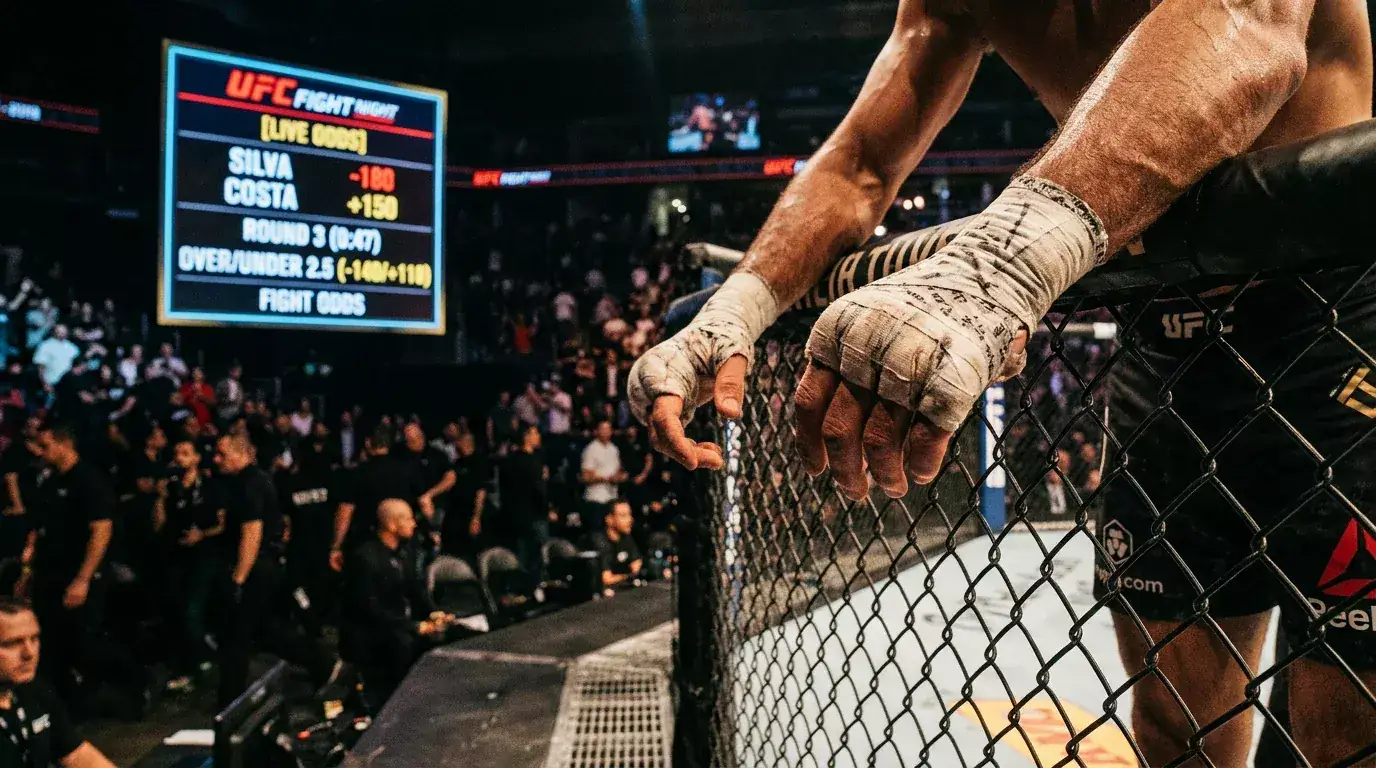
Live betting on UFC works differently from pre-fight markets because the odds update in near-real-time based on what is happening inside the octagon. Between rounds, bookmakers recalculate the prices based on strike counts, knockdowns, takedown success, and visible damage. Trip Stoddard, bet365's Head of Development, described the appeal of combat sports for live betting as an environment "where live action and fan engagement are inseparable" — and from a bettor's perspective, that inseparability creates constant repricing opportunities.
The key windows are the sixty-second breaks between rounds. This is when the largest odds swings occur, because the bookmaker's algorithm digests the round that just finished and adjusts. If a favourite lost a round convincingly but is not actually hurt, their odds often drift further than the tactical reality warrants. Conversely, if a heavy underdog steals a round on volume but has no real path to a finish, the market might overcorrect in their favour. Both scenarios create live value for bettors who understand fight dynamics rather than just reacting to what looks dramatic on screen.
A few practical realities temper the opportunity. Latency is genuine — there is always a delay between the broadcast feed and the actual event, and bookmakers know this. Streaming lag of even two to five seconds can mean the odds have already shifted by the time you see the moment that triggered the move. Cash-out timing during live UFC bouts is also tricky; the feature locks intermittently during active exchanges, so relying on cash-out as your primary risk management tool during a fight is unreliable.
Live UFC betting rewards patience, composure, and a pre-existing analytical framework for each fight. If you walk into an in-play market without having studied both fighters' tendencies across rounds, you are gambling on instinct — and instinct, in my experience, is an expensive habit. The full tactical breakdown of live betting — including when bookmakers systematically overreact and how to time between-round entries — is covered in live UFC betting.
Is Betting on UFC Legal in the UK? Regulation and Licensing
I get asked this at least once a week in my inbox: "Is it actually legal to bet on cage fights in the UK?" The short answer is yes, unambiguously. UFC betting is fully legal for UK residents aged 18 and over, provided you use a bookmaker licensed by the UK Gambling Commission (UKGC). There is no separate regulation for combat sports — MMA sits under the same licensing framework as football, horse racing, and every other sport available on regulated platforms.
UKGC licensing basics: Any operator accepting bets from UK customers must hold an active UKGC licence. This means segregated customer funds, mandatory responsible gambling tools, age verification, and adherence to advertising standards. You can verify any bookmaker's licence status on the Gambling Commission's public register.
What has changed recently — and what most punters are unaware of — is the pace of regulatory reform. The UK government's gambling White Paper, published in 2023, triggered a wave of implementation measures that are now landing. Two deserve particular attention from anyone betting on UFC in 2026.
From April 2025, UK online casino games are subject to a £5 maximum stake per spin for players aged 25 and over, extending to all ages in 2026. While this applies to casino products rather than sports betting directly, it signals the direction of travel: tighter controls, lower limits, and greater scrutiny of operator practices. Sports betting-specific affordability checks are under active consultation.
The second major change is the statutory gambling levy, effective from October 2025. This is a mandatory percentage of gross gambling yield that operators must pay into a fund for research, prevention, and treatment of gambling harm. Unlike previous voluntary contributions, this levy is legally enforceable and applies to all licensed operators. The immediate impact on punters is indirect — operators absorb the cost — but the long-term effect may include tighter margins, reduced promotional offers, or more aggressive affordability checks as operators seek to offset the additional expense.
One point that surprises many new bettors: gambling winnings in the UK are not taxable. Whether you win £50 or £50,000 from a UFC bet, you owe nothing to HMRC. The tax burden falls on the bookmaker, not the punter. This has been the case since the abolition of betting duty in 2001 and remains unchanged.
The regulatory environment is shifting, but the core framework is stable: UFC betting is legal, widely available, and well-regulated in the UK. The reforms underway are about consumer protection and operator accountability, not about restricting access to sports betting. If anything, a more tightly regulated market benefits serious bettors by ensuring that licensed platforms operate transparently and that the integrity of the markets you are betting into is actively monitored.
Responsible Gambling: Staying in Control
I have watched talented analysts — people with genuine edges in their models — destroy their bankrolls and their wellbeing because they could not separate the intellectual challenge of betting from the emotional pull of chasing losses. UFC's structure makes this risk particularly acute: with events nearly every weekend and live betting available throughout each fight, the opportunities to "make it back" never stop presenting themselves. That always-on quality is exactly what makes responsible gambling practices not optional but essential.
In 2025, 30% of young people in the UK participated in some form of gambling — up from 27% the year before. Tim Miller, Executive Director of Research and Policy at the UK Gambling Commission, noted that participation among young people is rising, even as the rate of problem gambling in that age group remains statistically stable at around 1.2% scoring four or above on the problem gambling severity scale. The gap between participation growth and problem gambling prevalence means more young bettors are entering the market, making early habit formation critical.

The overlap between UFC's core demographic and the population most at risk from gambling harm is not a coincidence. The sport's audience skews heavily toward the 18-34 age range — the same group driving the participation increase the Gambling Commission flagged. If you are in that demographic, the structural pull toward over-betting is real: the sport feels exciting, the events are frequent, and the mobile apps are designed to make placing a bet as frictionless as possible.
Self-check before any UFC betting session
- Am I betting with money I have explicitly allocated for this purpose, not funds needed for bills, rent, or savings?
- Have I set a session loss limit — and will I actually stop when I hit it?
- Am I placing this bet based on analysis, or because I want to recover a previous loss?
- Have I taken a break of at least 24 hours since my last betting session?
- If I lose this bet, will I feel anything stronger than mild disappointment?
Every UKGC-licensed bookmaker is required to offer deposit limits, loss limits, session time alerts, cooling-off periods, and self-exclusion. GAMSTOP provides a single registration that blocks you from all UK-licensed online gambling sites for a period you choose — six months, one year, or five years. These are not signs of weakness; they are tools, and using them is no different from using stop-losses in financial trading.
If you recognise a pattern where betting on UFC has shifted from a considered analytical exercise to something you feel compelled to do, the most important action is to talk to someone. GamCare (0808 8020 133) and the National Gambling Helpline offer free, confidential support. No amount of edge in your model is worth your mental health.
Frequently Asked Questions About Betting on UFC Fights
How do UFC betting odds work?
UFC odds represent the bookmaker's assessment of each fighter's probability of winning, expressed as a price. In the UK, odds are most commonly displayed in fractional format (e.g. 3/1) or decimal format (e.g. 4.00). To understand what the odds actually mean, convert them to implied probability: for fractional odds, divide the denominator by the sum of numerator and denominator, then multiply by 100. A fighter at 3/1 has an implied probability of 25%. The total implied probability for both fighters will exceed 100% — the excess is the bookmaker's margin. Comparing implied probability to your own assessment of the fight is the foundation of value betting.
What types of bets can I place on UFC fights?
UK bookmakers offer a wide range of UFC markets. The moneyline (fight winner) is the simplest — you pick who wins regardless of method. Method of victory lets you bet on whether the fight ends by KO/TKO, submission, or decision. Round betting allows you to predict the exact round of a finish or select a round group. Over/under rounds sets a total and you bet on whether the fight lasts longer or shorter. Proposition bets cover specific in-fight events like "fight to go the distance" or "first knockdown." You can also combine selections into accumulators, though these multiply both the potential payout and the bookmaker's edge.
Is betting on UFC legal in the UK?
Yes. Betting on UFC is fully legal for UK residents aged 18 and over, provided you use a bookmaker licensed by the UK Gambling Commission. MMA falls under the same regulatory framework as all other sports betting in the UK. There is no separate legislation governing combat sports wagering. You can verify any bookmaker's licence status on the Gambling Commission's public register. All licensed operators must provide responsible gambling tools, segregate customer funds, and comply with advertising standards.
What should I look for when choosing a UFC betting site?
Start with UKGC licensing — non-negotiable for legal protection and fund security. Then evaluate margin: the best UK operators price major UFC bouts with a combined overround below 4-5%, which directly affects your long-term profitability. Market depth matters too — check whether the platform offers method of victory, round betting, and props beyond just the moneyline, especially for Fight Night undercards. A responsive mobile app is essential given UFC events typically run late UK time. Finally, consider cash-out availability and in-play betting quality if live wagering is part of your approach.
Can I bet live during a UFC fight?
Yes. Most major UK bookmakers offer in-play betting on UFC events, with odds updating between rounds and sometimes during active fighting. The main betting windows open during the sixty-second breaks between rounds, when bookmakers recalculate prices based on strikes landed, knockdowns, takedowns, and visible damage. Live markets typically include the moneyline, over/under rounds, and sometimes method of victory. Be aware that streaming delay creates latency — odds may shift before you see the action that triggered the change — and cash-out functionality can lock during active exchanges.
Are UFC betting winnings taxable in the UK?
No. Gambling winnings in the UK are completely tax-free for the bettor. This applies to all forms of legal betting, including UFC. Whether you win £10 or £100,000, you owe nothing to HMRC. The tax burden falls on the bookmaker through point-of-consumption tax, not on the customer. This has been the case since the abolition of betting duty in 2001 and remains unchanged under current UK tax law.
What happens to my bet if a UFC fight is cancelled?
If a UFC fight is cancelled before it begins — whether due to injury, illness, weight miss, or any other reason — your bet is typically voided and your stake returned in full. This applies to single bets and to affected legs within accumulators (the remaining legs are recalculated without the voided selection). If a fight is stopped mid-bout due to an accidental clash — such as an unintentional headbutt or eye poke — the settlement depends on the specific bookmaker's rules, which usually reference whether a winner was declared on the scorecards at the point of stoppage. Always check the individual bookmaker's combat sports settlement rules before placing a bet.
Created by the ”Betting on ufc Fights” editorial team.